
Humanika · A vision of what could be
Jadar ΔΨ Hub
Water comes first. The place is the centre.
Jadar ΔΨ Hub is a vision of a place shaping its future around water, land and the knowledge of its people. It connects field research, MemBrain, a nursery, local food and small workspaces into a hub of renewal. Its measure is the capacity of a place to understand its condition and choose its next step.
Explore the vision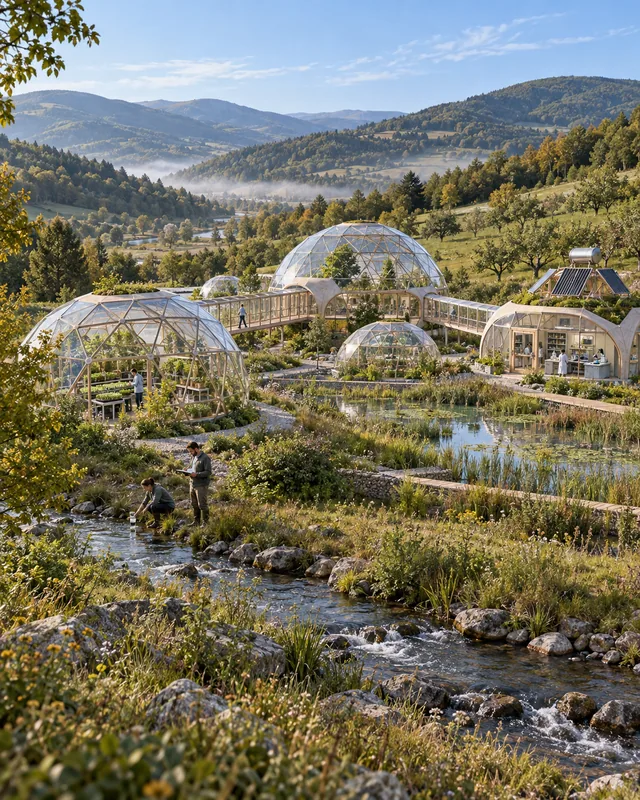
01 / Reading the place
Know the water before the first intervention
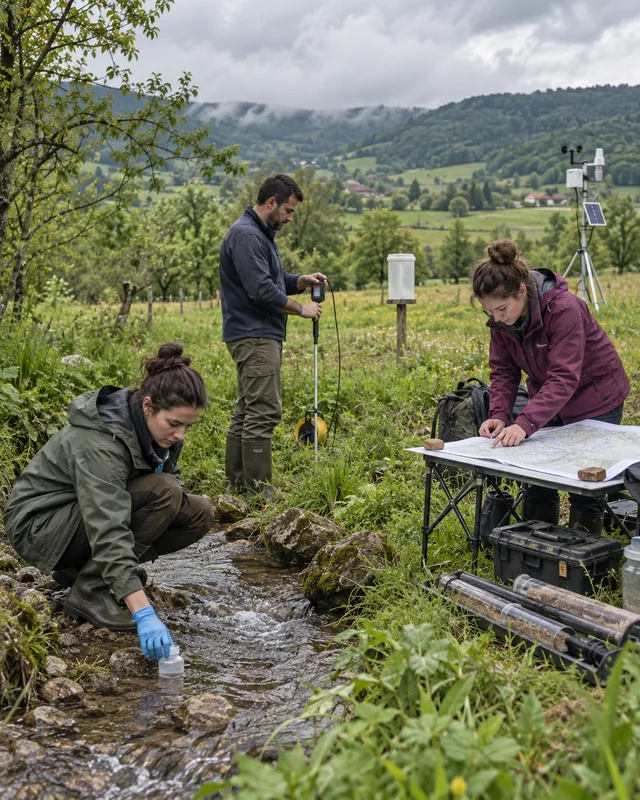
A stream, a well, a field and groundwater belong to the same landscape, yet reveal change differently. The starting point is sampling water, soil and sediment, following the seasons and mapping sources, flows and places where water stays. This baseline makes later changes visible.
Laboratory work is joined by the experience of people who know the ground: when a well weakens, where rain collects, how a stream behaves in a drought. Working together turns observations into questions that can be tested, and results into knowledge available to the whole community.
02 / Material research
MemBrain: an architecture for water
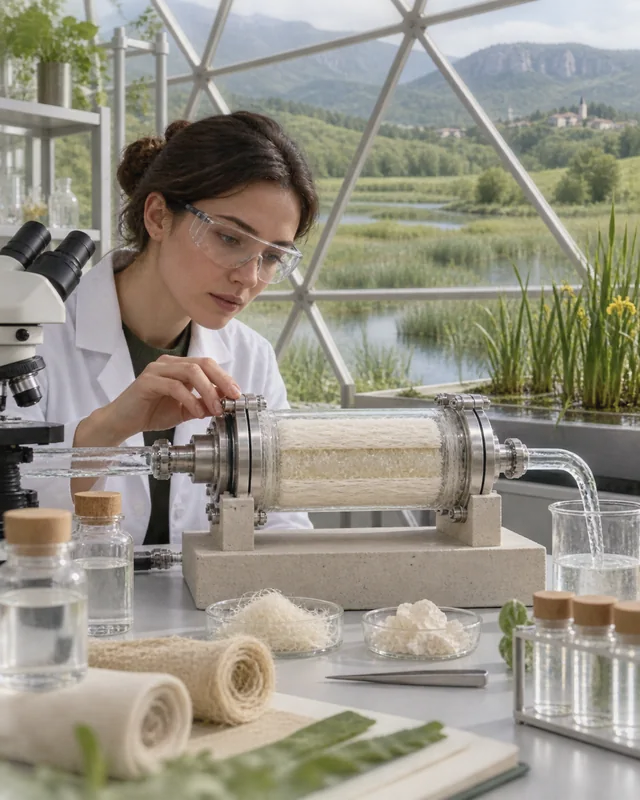
MemBrain is an original proposal for a membrane based on cellulose and borate chemistry. The research question is specific: could this material selectively separate certain constituents of water while keeping water itself the primary concern? An answer begins with a membrane sample and a carefully designed experiment.
A small research cell would examine what the membrane passes and retains, its durability and its behaviour over time. Comparison with existing methods includes energy, maintenance and the residue left behind. A result becomes useful when others can repeat it and every separated substance has an accounted destination.
03 / Living infrastructure
Small functions, working together
Water research can become the centre of a network of practical functions: a research wetland or pond, a nursery, seed and tool storage, and space for samples and measurement. Each part answers a particular need. Together they connect water stewardship with the renewal of vegetation and soil.
Processing and drying local food, workshops and learning spaces give this network a daily life between research cycles. Rest has a place in that rhythm too. Modules are added as people, work and a reason for them emerge; the centre grows according to what the place can use and maintain.
04 / What remains
A place remembers through its people
Measurements, maps and laboratory results should remain where their consequences last longest. The hub is also conceived as a meeting place for residents, hydrologists, biologists, chemists, craftspeople and those who work the land. Each brings part of the picture; a shared record preserves the whole.
A sampling workshop, a conversation about results or joint observation of water can be its first practical activities. When a particular project ends, equipment, contacts, experience and people able to ask the next question remain.
A useful hub leaves water, knowledge and the ability to continue.
From vision to practice
Development, step by step.
- 01
Understand the ground
Connect local observations with independent samples and seasonal monitoring of water, soil and sediment. Keep an accessible baseline.
- 02
Test at a small scale
Choose one research question and a bounded pilot. Agree beforehand what to measure, how to compare it and when to pause the experiment.
- 03
Build what is useful
Let results guide the next functions: a nursery, workshop, food space or research facility, developed with the people who will run them.
Open to collaboration
A future begins with local capacity
The next step needs people who know the water and the ground: residents, farmers, researchers and craftspeople. Cooperation can begin with one carefully framed question and a shared visit to the field.
Let’s talkA development vision, open to further work and collaboration. The illustrations show possible spaces and functions, not completed facilities.